How Long Does an Accident Affect Your Auto Insurance? (Lookback Periods & Rate Timelines)
If you are wondering how long does an accident affect…
Table of Contents
If you are wondering how long does an accident affect your insurance, the standard answer for most US drivers is three to five years (36 to 60 months). The rate hike hits on your first policy renewal following the payout, typically raising premiums by 25% to 50% depending on your state, prior driving history, and the total claim payout. Once that underwriting window expires, the surcharge drops off your premium calculation automatically.
However, the clock on your rate surcharge does not erase the event everywhere. While your carrier’s surcharge window generally closes around year three or five, state motor vehicle records and national underwriting loss databases track the collision for up to seven to ten years.
| Record / Tracking System | Active Impact on Rates | Total Retention Window | Governing Authority / Framework |
| Carrier Rating Period (Lookback) | 3 to 5 Years | 3 to 5 Years | State Insurance Commissioner Rate Filings |
| LexisNexis C.L.U.E. & Verisk A-PLUS | 3 to 5 Years (Rating Tier) | 7 Years | Fair Credit Reporting Act (15 U.S.C. § 1681c) |
| State DMV Driving Record (MVR) | 3 to 5 Years (Points) | 3 to 10+ Years (DUI/Felonies) | State Motor Vehicle Codes |
Insurance Lookback Periods vs. DMV Records: Understanding the Difference
Your state Department of Motor Vehicles (DMV) and your auto insurance carrier do not share the same retention rules or objectives.
Your state DMV tracks traffic convictions and driver licensing via your Motor Vehicle Record (MVR). If a police officer issues a moving violation citation at the scene—such as failure to yield or following too closely—points attach to your driver’s license under your state’s motor vehicle code. These points generally stay on your public driving record for three to five years, though major offenses like reckless driving or a DUI remain for 10 years or permanently.
Carriers evaluate financial risk using an experience rating period (the lookback period). When pricing your policy at renewal or onboarding you as a new customer, underwriters review two distinct data sources:
- Your State MVR: To verify moving violations, license suspensions, and active point totals.
- Underwriting Loss Reports: Primarily the Comprehensive Loss Underwriting Exchange (C.L.U.E.) operated by LexisNexis, or the A-PLUS database managed by Verisk.
These national loss databases log every claim filed under your name, driver’s license number, or vehicle identification number (VIN) for seven years. This includes property damage payouts to third parties, collision repairs on your own vehicle, Personal Injury Protection (PIP) payouts, comprehensive claims (theft, hail, glass), and zero-dollar claims closed without payment.
Even after your current insurer removes the surcharge at the 36-month mark, a new insurer can view the collision on your C.L.U.E. report for four additional years. While state regulations may prevent them from applying a direct “accident surcharge” past year five, they can use that loss history to decline your placement into their top “Preferred” rating tier.
How Premium Surcharges Decay Over 3 to 5 Years
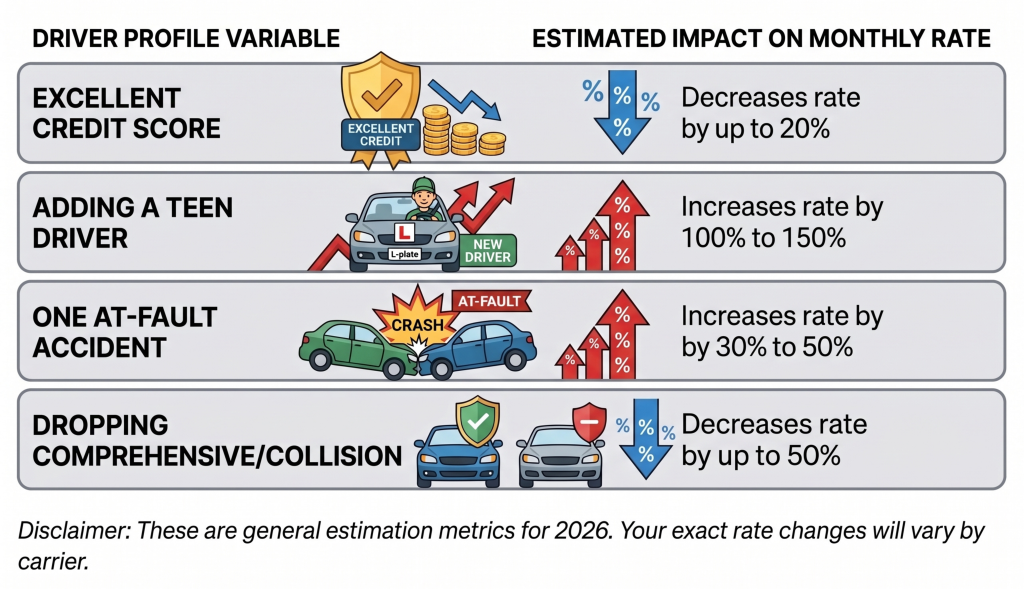
A rate increase after an accident is rarely a static fee that vanishes overnight. Major carriers calculate rate adjustments using an insurance-department-approved sliding point tier.
The Year-by-Year Surcharge Trajectory
The financial penalty follows a rolling step-down across consecutive policy terms:
- Year 1 (Months 1–12): The financial impact peaks here. Once your insurer closes the claim or sets a paid-loss reserve, your subsequent six-month or annual renewal reflects the full loss surcharge. You also lose your “claims-free” or “safe-driver” discount, compounding the bill.
- Years 2 & 3 (Months 13–36): Surcharges decrease incrementally. As long as you maintain an otherwise clean record—no moving violations, secondary collisions, or comprehensive claims—the points assigned to that specific collision scale down on each renewal cycle.
- Years 4 & 5 (Months 37–60): Standard private passenger auto carriers drop the remaining surcharge after month 36. Non-standard, high-risk carriers (such as those insuring high-risk drivers with SR-22 filings) may retain a diminished surcharge through month 60, after which state rate filings require complete removal.
Monetary Thresholds for Chargeable Accidents
Not every fender bender gives your insurer the legal right to apply an accident surcharge. State insurance codes establish chargeable accident thresholds below which carriers cannot penalize you:
- New York (11 NYCRR Part 169 / Regulation 100): Insurers cannot apply an accident surcharge if the total property damage remains at or below $2,000 and there is no bodily injury payout.
- Massachusetts (211 CMR 134.00): The Safe Driver Insurance Plan (SDIP) separates incidents into minor at-fault accidents (claims between $1,000 and $5,000) and major at-fault accidents (exceeding $5,000 or involving bodily injury). Surcharges cannot be assessed on property damage below $1,000.
- California (Cal. Ins. Code § 1861.02): Under Proposition 103, an accident is only chargeable if the driver is determined to be principally at fault (more than 50% responsible) and the property damage payout exceeds the state’s regulatory reporting threshold (historically $1,000) or results in bodily injury/death.
Do Not-At-Fault Accidents Increase Your Insurance Rates?
If another driver hits your vehicle and you bear zero legal liability, your base rate should remain unaffected. Whether your total bill increases depends on your state’s statutory protections and how your carrier structures its discount programs.
Statutory Protections by State
- California: Cal. Ins. Code § 1861.02 strictly forbids insurers from adding a surcharge or increasing base premiums for accidents where you were not principally at fault.
- Oklahoma: 36 O.S. § 941 bars insurers from increasing auto insurance premiums solely because the insured was involved in a collision caused by another party.
- New York: 11 NYCRR § 169.1 prohibits surcharges when the vehicle was struck while legally parked, hit from behind while stopped, or where the other driver was cited or convicted for moving violations causing the collision.
The “Zero-Fault” Rating Workarounds
In states lacking these statutory shields, insurers frequently use indirect methods to raise premiums:
- Loss of Claims-Free Discounts: The policy does not add an explicit “accident penalty,” but the carrier rescinds a 15% to 20% safe-driver credit because a loss payment was logged on the file.
- Subrogation Deficits: If your insurer pays for your vehicle’s repairs under your collision coverage and attempts to recover the funds from the at-fault driver’s carrier (subrogation), but the other driver was uninsured or underinsured, the unresolved loss payout can stay on your record as an active claim.
- Comparative Negligence Splits: In modified comparative fault states (such as those using a 50% or 51% fault bar), if an adjuster assigns you even 10% or 20% comparative fault for failure to take evasive action, the carrier may reclassify the incident from non-fault to a chargeable loss.
To protect your risk tier following an accident caused by another party, read our procedural guide on what to do after a car accident not your fault to properly secure third-party liability admissions and police crash report entries before adjusters assign internal fault codes.
The 7-Year C.L.U.E. Report: How to Fix Erroneous Fault Entries
If an insurance claims representative assigns an inaccurate fault code, that mistake follows you across every new carrier quote for the next seven years.
Under the Fair Credit Reporting Act (FCRA), 15 U.S.C. § 1681i, specialty consumer reporting agencies must investigate disputed entries within 30 days of receiving notice.
Step-by-Step C.L.U.E. Dispute Procedure
- Request Your C.L.U.E. Auto Report: Access your free annual disclosure through the LexisNexis Consumer Portal under your FCRA statutory rights.
- Audit the Loss Entries: Check the “Disposition” and “Claim Type” columns for each listed event. Verify that a comprehensive glass repair is not categorized as a collision loss, and ensure a non-fault collision is not coded with an at-fault liability payout.
- Assemble Corroborating Evidence: Gather the official state police collision report showing zero driver fault, the formal subrogation release from your carrier showing 100% loss recovery from the third party, or the signed settlement notice from the adverse insurer.
- Submit a Formal Dispute with LexisNexis: Provide your documentation and state clearly: “The claim on [Date of Loss] is coded inaccurately as an at-fault loss. Per the attached police crash report and adverse insurer settlement letter, I was zero percent at fault.”
- Secure an Insurer Experience Letter: Call the claims supervisor at the insurer that handled the payout and request an official Letter of Experience. This document must state your policy number, vehicle VIN, exact date of loss, total amounts paid, and explicit verification that the claim closed with zero liability assessed against you.
When to File a Claim vs. Paying Out of Pocket

When you are involved in a single-vehicle scrape—backing into a bollard, scraping an automated garage gate, or sliding off a private driveway—filing a collision claim can cost more in premium inflation than the cash repair value.
Use this operational formula before calling your insurance company:
Understanding how long does an accident affect your insurance helps you calculate whether filing is worth the long-term cost.
Repair Evaluation Decision Rule:
If (Projected 3-Year Surcharge + Your Deductible) > Out-of-Pocket Cash Repair Estimate:
--> Pay cash at a reputable body shop. Do not notify the insurer.

If Third-Party Property Damage or Any Bodily Injury Exists:
--> File the claim immediately. Policy terms require immediate reporting to preserve your liability defense.
Scenario Breakdown:
- Your annual premium is $1,600.
- A certified repair shop estimates body and paint repair at $1,400.
- Your collision deductible is $500.
- Filing a claim: Your carrier covers $900 ($1,400 repair minus $500 deductible). In return, an average 35% surcharge adds $560 per year to your premium. Over three years, you pay $1,680 in surcharges. Combined with your $500 deductible, your out-of-pocket exposure reaches $2,180.
- Result: Paying $1,400 out of pocket saves you $780 net over three years and keeps your loss record clean.
The Golden Exception: If another vehicle, municipal asset, or private property owner is involved, you must report the loss. If the other party later reports injuries or additional property damage to their carrier, failing to notify your insurer breaches your policy’s notice and cooperation clause, which can result in denial of coverage and loss of legal defense.
If the collision involves a vehicle you are financing or leasing that suffers severe frame damage, review our guide on what gap insurance covers before accepting an adjuster’s cash valuation offer.
Strategies to Lower Your Premium While an Accident Is on Your Record
You do not have to accept elevated rates while waiting out the 36-month lookback period. Use these four methods to lower your baseline rate immediately:
- Reshop Exactly at Day 1,096 (The 36-Month Cutoff): Many regional and national carriers (e.g., Travelers, Progressive, GEICO) set their underwriting lookback strictly at 35 or 36 months. A policy quote run on day 1,090 includes the accident; the exact same quote run on day 1,096 excludes it from rating formulas. Mark your calendar for the third anniversary of the loss date.
- Complete a State-Approved Defensive Driving Course: Multiple states mandate rate reductions by statute upon course completion. In New York, the Point and Insurance Reduction Program (PIRCDS) requires insurers to apply a 10% discount on liability, no-fault, and collision premiums for three consecutive years. New Jersey and Texas offer similar statutory credits.
- Restructure Your Deductible Mix: Increasing your collision and comprehensive deductibles from $500 to $1,000 lowers the physical damage premium by 10% to 25%, offsetting a significant portion of the accident surcharge while maintaining catastrophe coverage.
- Verify Vehicle Ownership and Driver Assignment: If multiple vehicles and drivers are on the same policy, verify that the driver who had the accident is assigned to the lowest-value vehicle on the policy declaration page. If you are operating a car titled to a third party, consult our analysis on whether you can insure a car not in your name to confirm primary liability assignment.
Frequently Asked Questions
Does the three-year clock start on the accident date or the payout date?
The lookback period begins on the date of loss (the actual date of the collision), not the date your claim is resolved, paid, or closed in the carrier’s system. If an underwriter applies an accident surcharge based on the claim closure date, demand an underwriting correction backed by your police crash report.
Does an accident affect my insurance if I was driving someone else’s vehicle?
Auto insurance follows the vehicle first (primary coverage), but driving records follow the driver.
If you cause an accident in someone else’s car, the owner’s collision and liability coverage pays out first. However, if the damages exceed the owner’s liability limits, your personal auto insurance policy serves as secondary coverage. Regardless of who pays for vehicle repairs, any moving violation or citation issued at the scene attaches to your driver’s license number, appearing on your personal MVR and C.L.U.E. profile.
Can an insurer cancel my policy immediately after an at-fault accident?
No. State insurance regulations strictly limit mid-term policy cancellations to three statutory triggers: failure to pay premium, material misrepresentation/fraud during the application, or suspension of your driver’s license.
An insurer cannot cancel your policy mid-term simply for having an accident. Instead, they will issue a Notice of Non-Renewal 30 to 60 days before your policy’s expiration date if the loss exceeds their underwriting risk parameters.
Your Action Checklist
- Confirm the Official Loss Date: Call your claims adjuster and confirm the exact date of loss logged in your file. Surcharge expirations depend entirely on this date.
- Track the Payout Total: Ask your adjuster for the total dollar amounts paid under Property Damage Liability, Collision, and Personal Injury Protection (PIP)/Bodily Injury. Compare this sum against your state’s chargeable threshold.
- Pull Your C.L.U.E. Report at Month 36: Access your free report from LexisNexis to ensure the claim reflects the proper fault coding and settlement status.
- Compare Rates Across Carriers on Month 36, Day 1: Run quotes across at least three competing carriers the day your lookback period clears to secure immediate tier reassignment.